Decision Architecture: The Hidden Force Shaping Every Trade
You've studied technical analysis, risk management, and trading psychology. You've backtested your strategy. You know the rules: Risk 1-2% per trade, use proper stop losses, follow your system.
So why do even funded traders keep breaking their own rules?
Most traders blame themselves: "I lack discipline," "I'm too emotional."
But here's a different explanation—one that has nothing to do with your character and everything to do with decision architecture.
What Is Decision Architecture?
Decision architecture is the structural environment in which decisions are made. It's not about what you know; it's about how the tools and systems around you shape what you actually do when capital is on the line.
Consider a simple example:
Scenario 1: Poor Architecture
You promise yourself you'll eat healthier, but junk food is visible and convenient in the kitchen.
⚠️ Requires constant willpower to resist
You fight your environment all day long
Scenario 2: Good Architecture
You remove junk food. Healthy options are visible and convenient.
✓ The right choice is easy; the wrong choice requires effort
Your environment supports your goals
Same person, same goals — completely different outcomes based on architecture alone
Decision architecture determines how much cognitive effort is required for good decisions. When architecture is poor, you fight your system. When it's good, protective systems operate naturally, and bad decisions require effort to override.
Your Trading Platform Is Your Decision Architecture
Most traders evaluate platforms based on execution features (speed, indicators, commissions). These matter once you've made a good decision, but they do nothing to help you make one in the first place.
Your platform's architecture determines:
- What critical risk information is visible when you need it.
- How much cognitive effort good decisions require.
- Whether errors are prevented structurally or must be caught consciously.
- Which cognitive systems get engaged (fast pattern recognition vs. slow calculation).
Most platforms have terrible decision architecture. They were designed as execution engines, not decision support systems. They assume you'll make rational calculations under pressure and provide no structural protection when your brain fails.
How Your Brain Actually Trades
To understand the failure, you need to understand how your brain works under pressure.
System 1 and System 2 Thinking
Psychologist Daniel Kahneman describes two cognitive systems:
System 1: Fast, Automatic, Pattern-Based
- • Operates unconsciously
- • Excels at spatial and visual reasoning
- • Robust under stress
System 2: Slow, Analytical, Calculation-Based
- • Requires conscious effort
- • Handles mathematics
- • Degrades severely under stress, fatigue, or emotional pressure
Here's the problem: Most trading platforms require System 2 thinking at exactly the moments when System 2 fails. You are asked to perform mental arithmetic and logical reasoning while under time pressure and emotional stress—a recipe for predictable failure.
The Working Memory Bottleneck
Your working memory—where conscious thinking occurs—can hold roughly four items at once. That's a hard limit.
When placing a trade, you are already juggling:
- Current market price
- Intended entry level
- Stop loss calculation
- Take profit calculation
- Position size determination
- Account balance/Max risk check
You've exceeded capacity before you even consider market context. Under stress, System 2 degrades further. You make arithmetic errors and transpose digits. This isn't a character flaw; it's a predictable limitation of human cognitive architecture.
Cognitive Load Comparison: Traditional vs. Modern Platform
Traditional Platform
⚠️ System 2 Overloaded - Critical thinking impaired
Modern Platform (Trade Plotter)
✓ Cognitive capacity available for strategy
The Power of Externalized Cognition
Platform design is critical because it can leverage externalized cognition: offloading mental work from your brain to your environment.
Example: Stop Loss Placement
Traditional Approach (System 2)
Calculate:
$1.0850 - 0.0030 = 1.0820
Enter:
Type "1.0820" into a box.
Result:
Requires arithmetic under pressure.
Architecture-Supported (System 1 + Platform)
Drag:
Stop line to intended level on chart.
Platform Calculates:
Distance (e.g., 30 pips) is displayed automatically.
Result:
Engages Visual-Spatial Reasoning (System 1) and Pattern Recognition.
The traditional approach requires effortful calculation that fails under stress. The good architecture uses fast, reliable pattern recognition supported by automated calculation.
A Concrete Example: The Risk Mismatch
Consider placing a 15-pip stop.
Traditional Platform
You type the number 1.0835 and execute. When volatility hits, you're stopped out.
❌ Outcome:
You realize too late the stop was insufficient for the 40-pip bar range.
The loss is realized.
Visualized Platform
You must place the stop line on the chart first. You immediately see the stop sitting inside the recent 40-pip bar range.
⚡ Your visual cortex screams:
"Too tight!"
✓ Outcome:
You adjust the stop to 40 pips and execute with appropriate risk.
Error prevented before execution.
The difference: Decision architecture converted a calculation task into an automatic pattern recognition task. You didn't consciously calculate "volatility has doubled"; you saw the spatial mismatch and your brain instinctively knew something was wrong.
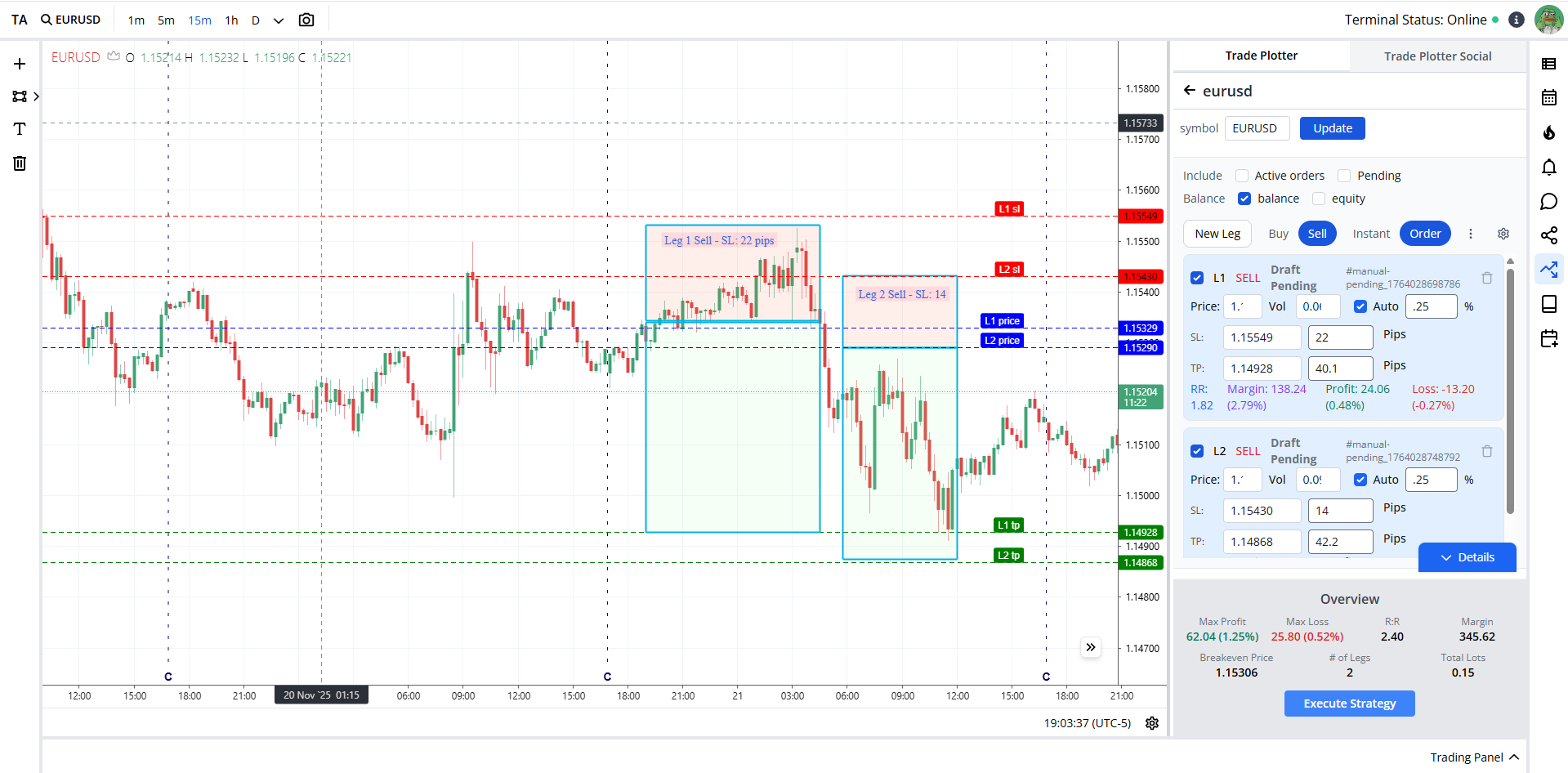
Trade Plotter platform showing visual stop loss placement directly on the chart
The difference: Decision architecture converted a calculation task into an automatic pattern recognition task. You didn't consciously calculate "volatility has doubled"; you saw the spatial mismatch and your brain instinctively knew something was wrong.
From Execution Engine to Decision Support System
Traditional platforms are execution engines. They faithfully implement whatever you tell them, good decision or bad.
Platforms with good architecture are decision support systems. They help you make better decisions by:
- Externalizing Cognition: Showing derived insights instead of raw data.
- Engaging Reliable Systems: Using visual pattern recognition instead of mental arithmetic.
- Creating Forcing Functions: Making bad decisions look structurally wrong before execution.
- Reducing Cognitive Load: Automating calculations that consume working memory.
Good architecture plays to human strengths (pattern recognition); bad architecture forces humans to compensate for weaknesses (mental math under pressure).
Why Most Platforms Fail
Most platforms persist with poor architecture due to:
- Legacy Design Assumptions: Designed decades ago assuming traders are perfectly rational and execution speed is the only metric that matters.
- The Speed Obsession: Developers prioritize execution speed (microseconds) over structural error prevention. Fast execution is great after a good decision; it's disastrous when it enables a revenge trade in 6 seconds.
- Technical Complexity: Good decision architecture—with real-time aggregation and visualization—is technically harder than just showing order boxes.
What Good Architecture Looks Like
Good decision architecture in trading platforms is defined by these shifts:
| Traditional (Bad Architecture) | Modern (Good Architecture) | Cognitive Benefit |
|---|---|---|
| Numerical: Stop loss price 1.0820. | Visual: Stop loss line plotted on the chart. | Engages fast System 1 pattern recognition. |
| Raw Data: Three positions show separate P&L. | Derived Insight: "Total portfolio risk: -3.7% if all stops hit." | Offloads arithmetic from working memory. |
| Warning: "Large position size." | Forcing Function: Must visually place stop before execution, seeing consequence. | Structurally prevents errors that warnings allow. |
The fundamental question is: Is my platform structurally designed to make following my rules easy—or does it require superhuman cognitive capacity and willpower?
Where this shows up: Trade Plotter
The concepts explored here—leveraging System 1 processing, mitigating working memory overload, and creating visual forcing functions—are the foundational principles of the Trade Plotter feature in FXAthena.
We didn't just build an order entry panel; we built a cognitive architecture optimized for high-stakes decision-making. Trade Plotter is FXAthena's multi-leg management feature designed to eliminate cognitive overload during complex trade execution.
The same logic exposes a deeper problem most traders never see: the business model behind the free terminal itself, and why it was never built to protect you. We unpack that in Inside the B-Book.